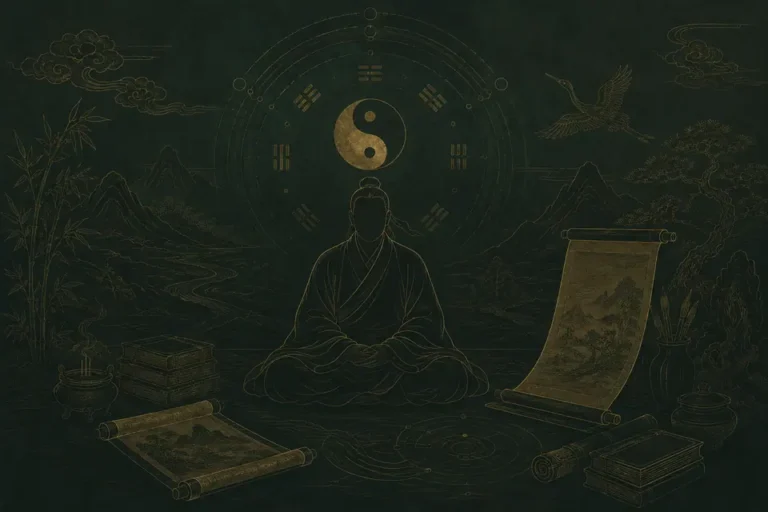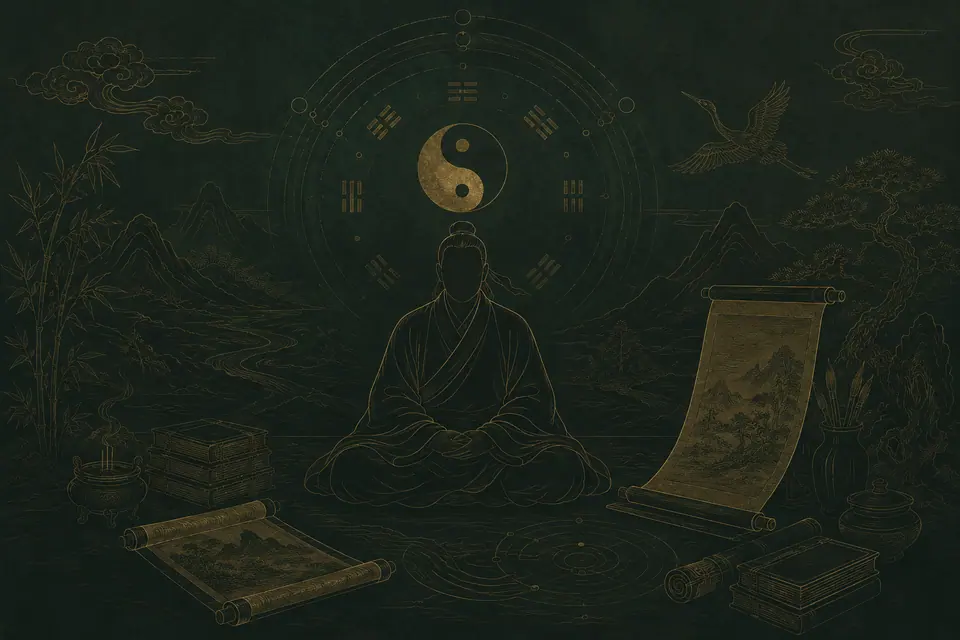
A Daoist daily routine does not need to look dramatic. For busy professionals, the most useful routine is often small, repeatable, and quiet enough to survive a real schedule.
Use it as a cultural practice framework for breath, posture, movement, and daily rhythm.
The principle: return before you are exhausted
Many people wait until the end of the day to repair the day. A Daoist-inspired rhythm asks for smaller returns:
- Return to the breath before a meeting.
- Return to posture before a difficult message.
- Return to stillness before sleep.
- Return to movement before the body becomes stiff.
The routine does not need to be long. It needs to be available.
Morning: three minutes of standing
Before opening your phone, stand for three minutes.
Let the feet settle. Let the shoulders soften. Let the breath return without control. If you know a Tai Chi or Baduanjin movement, repeat one simple movement. If not, stand quietly.
The morning goal is not productivity. The goal is orientation.
Midday: one movement reset
Choose one small movement:
- Lift and lower the arms with breath.
- Shift weight from foot to foot.
- Circle the shoulders slowly.
- Walk without looking at a screen for two minutes.
The midday goal is not exercise volume. The goal is to interrupt tension before it becomes the whole day.
Afternoon: one boundary cue
Afternoon attention often becomes scattered. Use one boundary cue:
- Close unused tabs.
- Put both feet on the ground before replying.
- Take one slower exhale before a decision.
- Step away from the desk for one minute.
This is where Metal language can be useful: clarity, release, and boundary.
Evening: a small closing ritual
The evening does not need to be elaborate. Try this:
- Dim the screen.
- Sit quietly for three minutes.
- Write one sentence: "What did I carry today?"
- Write one sentence: "What can I put down?"
This turns reflection into a daily practice rather than an occasional crisis response.
Weekly rhythm
For the first week, do not add more than this:
- Three minutes standing in the morning.
- One movement reset at midday.
- One closing reflection at night.
If you can repeat that for seven days, you have a foundation.
When to go deeper
Go deeper when one of these is true:
- You want a structured beginner course.
- You want teacher correction for movement.
- You want help choosing between Tai Chi, Baduanjin, breath, or stillness.
- You want cultural consultation around Five Elements, naming, Feng Shui, or field learning.
Try the Five Elements Profile as a gentle first reflection step, then return to the Knowledge Base for broader context.
Key Terms
A repeatable pattern of small actions that gives practice a place in ordinary life.
A reader with limited time who needs realistic practice design rather than idealized schedules.
A brief action, often under five minutes, that keeps continuity when time is limited.
A simple cue used when moving between work, home, rest, and study.
A short breathing pause used to soften reactivity and return to attention.
A deliberate closing of work mode so rest and reflection can begin.
A periodic check that notices what supported balance and what created friction.
A practice principle that values consistency, rest, and clarity over intensity.
Use this article as one entry in the wider Daoist Roots knowledge archive.
Source Notes
This article is written for cultural education and beginner orientation. It should be read as context for learning, not as medical, legal, financial, or deterministic advice.
Disclaimer
Daoist Roots articles are for cultural education and reflective learning. They are not medical, legal, financial, or mental health advice, and they do not replace qualified professional guidance.