Many people hear “Five Elements” and expect a fixed fortune map. For daily practice, it can be more useful as a language for rhythm.
In this article, we use the Five Elements as a practical framework for observing patterns, balancing attention, and making small adjustments to daily habits.
What We Mean by “Five Elements” in Everyday Life
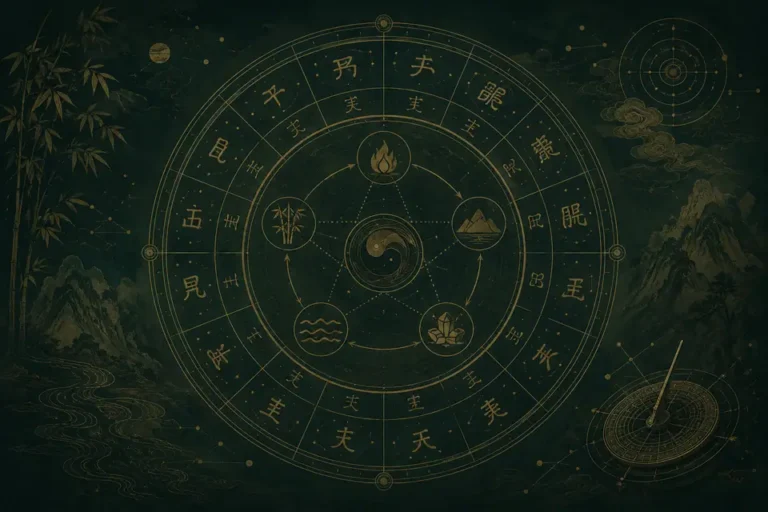
In Daoist contexts, the Five Elements are commonly explained as wood, fire, earth, metal, and water. Different traditions use different interpretive details, but for practical content we can treat them as a habit language:
- Wood: initiative, planning, forward movement
- Fire: communication, expression, momentum
- Earth: stabilization, rest, recovery routines
- Metal: boundary setting, refinement, cleanup
- Water: reflection, adaptability, deep attention
This framing is not a spiritual shortcut. It is a way to describe what tends to happen across a day or a week. If your energy is scattered, your schedule probably needs pacing. If your schedule is rigid, your body probably needs transition points. If your communication is sharp and tense, your environment may need softening.
Why This Matters for Search Content and People Searching on the Site
Our content audience usually arrives with one of these intents:
- “Where do I start?”
- “How can I avoid overdoing practice?”
- “How can this help me learn consistently?”
The Five Elements framing answers these intents best when we connect it to time, space, and attention. Readers often look for this topic through questions such as:
- “five elements daily routine for beginners”
- “how to build a calm daily rhythm with Daoist practice”
- “simple daoist lifestyle structure”
A Simple Morning-to-Night Mapping
Use this as an observational model, not a hard rule:
Morning (Wood + Water): Opening and Intention
Before screens, place one sentence for the day: “Today I will begin with awareness, not pressure.” Take 3 minutes of breath and posture check.
Mid-Morning (Fire): Attention and Expression
Keep work blocks in 30- to 45-minute cycles with brief micro-pauses. If your communication is tense, shift tone and posture first.
Early Afternoon (Earth): Reset and Grounding
Short walk, hydration, and a simple reset habit: one stretch, one pause, one note. This is not a productivity hack; it is a transition ritual.
Late Afternoon (Metal): Boundary and Completion
Tidy one area: desk, files, or note list. Completion gives the mind evidence of finishing, reducing scattered re-entry into work.
Evening (Water): Reflect and Release
Write 2 lines in a notebook: “What rhythm felt natural today?” and “Where did I force continuity?” Do not force emotional conclusions.
Avoiding Common Mistakes
Mistake 1: Turning Elements into Rigid Labels
Some people label every feeling as “fire overload” or “water deficit.” That creates anxiety. Better approach: observe for 7 days and collect patterns.
Mistake 2: Chasing Balance as a Perfect State
The goal is not perfect equilibrium. The goal is clearer observation and gentler transitions.
Mistake 3: Confusing Reflection with Prediction
The Five Elements can help with reflection. It should not be used to make certainty claims.
7-Day “Observe, Not Fix” Challenge
For beginners, we suggest the same challenge across all pages:
Day 1: Identify one recurring pressure point. Day 2: Add one 2-minute pause before first major task. Day 3: Choose one environment edge (desk edge, doorway, screen timing) to simplify. Day 4: Replace one habit loop with a slower transition. Day 5: Add one 3-minute stillness period. Day 6: Reflect on communication tone during one conversation. Day 7: Re-write your rhythm in one paragraph.
This is a starter rhythm that can be adjusted as your daily routine becomes clearer.
Where to Learn More on the Site
- Start with Five Elements Profile if you want structured observations.
- Compare movement paths in Baduanjin for Beginners and Tai Chi Foundations.
- If you need a personal guidance route, request a Consultation.
Further context for careful reading
For readers who want evidence-minded framing:
- NCCIH on Tai Chi and mind-body movement practices.
- WHO Traditional Medicine strategy pages for context on how traditional practices are studied.
- UNESCO and regional cultural resources for Longhu Mountain and heritage context when introducing the place dimension.
Use this article as one entry in the wider Daoist Roots knowledge archive.
Key Terms
Wood, Fire, Earth, Metal, and Water as a relational language for change and rhythm.
Growth, movement, planning, and flexible direction.
Expression, warmth, visibility, and activity.
Stability, nourishment, transition, and grounding.
Structure, clarity, refinement, and boundaries.
Rest, depth, reflection, and recovery.
The way energy, attention, and tasks move across a day.
A way to observe patterns without turning them into fixed labels.
Article Guide
Key Terms
Five Elements
Wood, Fire, Earth, Metal, and Water as a relational language for change and rhythm.
Wood
Growth, movement, planning, and flexible direction.
Fire
Expression, warmth, visibility, and activity.
Earth
Stability, nourishment, transition, and grounding.
Metal
Structure, clarity, refinement, and boundaries.
Water
Rest, depth, reflection, and recovery.
Daily rhythm
The way energy, attention, and tasks move across a day.
Practical lens
A way to observe patterns without turning them into fixed labels.
Source Notes
Sources
- Editorial guide — Daoist Roots cultural education and reflective learning standard.
- Article source notes — maintained in WordPress content and ACF Knowledge Fields.
Disclaimer
Daoist Roots articles are for cultural education and reflective learning. They are not medical, legal, financial, psychological, or guaranteed outcome advice, and they do not replace qualified professional guidance.