Five Elements language can be useful when it helps you choose a small practice. It becomes less useful when it turns into a fixed label. You are not only wood, fire, earth, metal, or water. You are a person with changing rhythm, context, habits, and seasons.
This guide explains how to use Five Elements as a practice map, especially when choosing a first breathing or movement cue.
Start with rhythm, not identity
The simplest question is not "What element am I?" A better beginner question is:
> What kind of rhythm do I need today?
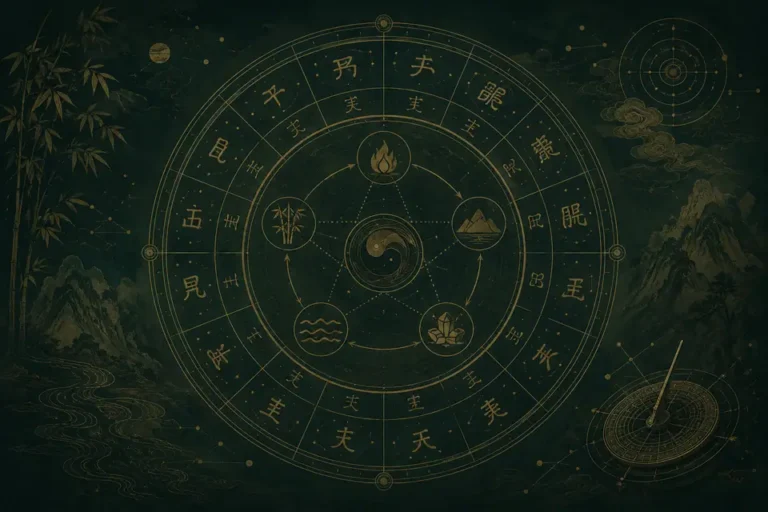
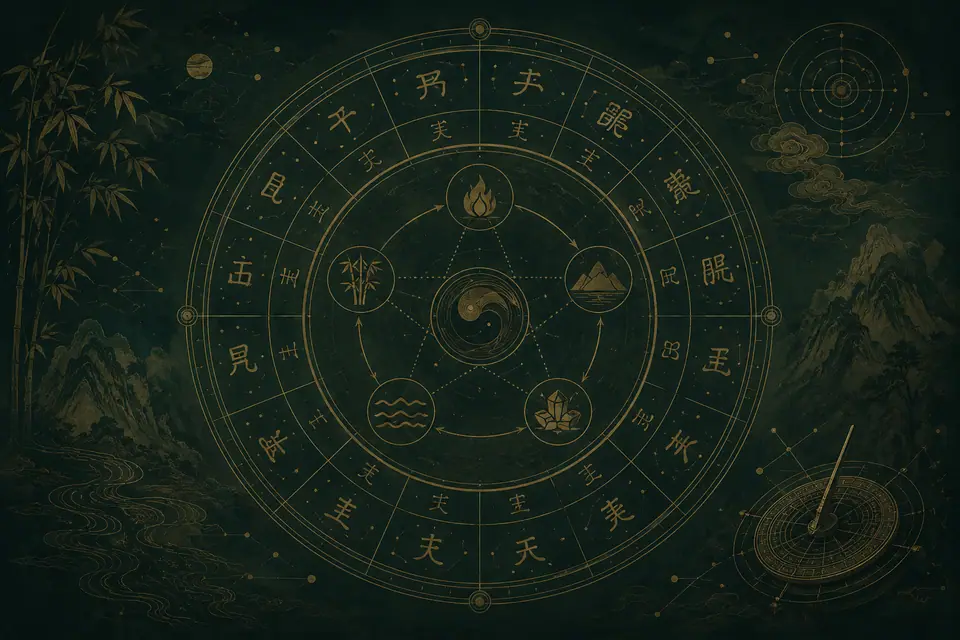
Five Elements can give vocabulary for that question:
- Wood: growth, direction, beginning, movement.
- Fire: expression, warmth, attention, excitement.
- Earth: steadiness, nourishment, repetition, center.
- Metal: structure, clarity, release, boundary.
- Water: rest, depth, quiet, recovery.
These are cultural symbols, not diagnoses.
If your day feels like Wood
Wood can feel like planning, rising, stretching, or pushing forward. A useful first practice is gentle expansion with clear limits.
Try this:
- Stand quietly.
- Inhale and let the arms float outward.
- Exhale and let the arms return.
- Repeat for three minutes.
The point is not to chase ambition. It is to move forward without becoming rigid.
If your day feels like Fire
Fire can feel expressive, bright, restless, or overstimulated. A useful first practice is cooling the pace.
Try this:
- Sit or stand comfortably.
- Inhale naturally.
- Exhale slightly longer than the inhale.
- Let the eyes soften.
Do this for three minutes, especially before responding to messages.
If your day feels like Earth
Earth can feel steady, caring, heavy, or repetitive. A useful first practice is grounding without sinking.
Try this:
- Stand with feet grounded.
- Shift weight slowly from one foot to the other.
- Keep the breath easy.
- Stop before it becomes effortful.
This works well before meals or between work blocks.
If your day feels like Metal
Metal can feel clear, organized, strict, or tense. A useful first practice is structured breathing with a soft ending.
Try this:
- Inhale for a comfortable count.
- Pause briefly.
- Exhale and release the shoulders.
- Repeat without forcing the breath.
Metal practice should create clarity, not pressure.
If your day feels like Water
Water can feel quiet, deep, tired, or withdrawn. A useful first practice is slow attention.
Try this:
- Sit with both feet touching the ground.
- Notice the lower belly.
- Let the breath move naturally.
- Do less than you think you should.
Water practice often begins with permission to rest.
The safe boundary
Five Elements practice works here as a cultural framework for reflection and daily practice selection.
Use it to begin gently. If your question needs personal context, birth-time systems, naming, Feng Shui, or ritual culture, move from a free tool into human consultation.
Start with the Five Elements profile, then choose a beginner course or consultation path.
Use this article as one entry in the wider Daoist Roots knowledge archive.
Key Terms
A simple way to begin observing rhythm, tension, and attention.
A symbolic framework for understanding different qualities of change.
The first small action that makes a larger system approachable.
Returning attention to the body and present moment.
Noticing patterns before trying to interpret them.
Choosing what to do first so learning stays manageable.
Using Wood, Fire, Earth, Metal, and Water as gentle prompts.
A rhythm that can be repeated without strain.
Article Guide
Key Terms
Breath practice
A simple way to begin observing rhythm, tension, and attention.
Five Elements
A symbolic framework for understanding different qualities of change.
Starting point
The first small action that makes a larger system approachable.
Grounding
Returning attention to the body and present moment.
Observation
Noticing patterns before trying to interpret them.
Practice order
Choosing what to do first so learning stays manageable.
Elemental reflection
Using Wood, Fire, Earth, Metal, and Water as gentle prompts.
Sustainable routine
A rhythm that can be repeated without strain.
Source Notes
Sources
- Editorial guide — Daoist Roots cultural education and reflective learning standard.
- Article source notes — maintained in WordPress content and ACF Knowledge Fields.
Disclaimer
Daoist Roots articles are for cultural education and reflective learning. They are not medical, legal, financial, psychological, or guaranteed outcome advice, and they do not replace qualified professional guidance.